
Giving USA 2026: The Nonprofit Leader’s Practical Guide
While the Giving USA 2026 report tells us what happened in philanthropy over the past year, it does not always tell nonprofit leaders what they should do next. Below is both a summary of the key findings from the report and actionable next steps for organizations to consider moving forward.
Table of Contents:
Executive Summary
Activating the Insights
Investing in Major Gift Relationships with Guidance from Portia Fullard
Cultivating Generational Philanthropy
Making Planned Giving Part of the Conversation
Reflections from Judge Marjorie Rendell on Family Philanthropy
Considerations from Bill Smilow on Building the Smilow Foundation
Next Steps
Executive Summary
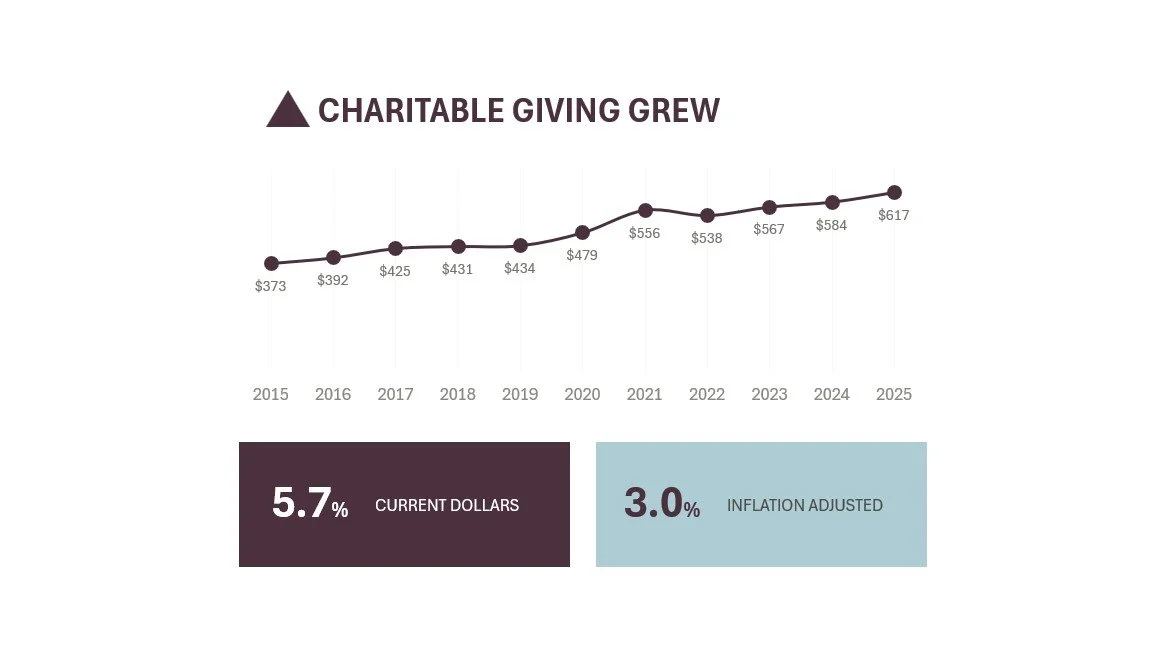
Download the accompanying slide deck for a visual executive summary of the Giving USA 2026 report, with key findings, charts, and visuals designed to make the data easy to share and discuss. Use the deck in presentations with your board, colleagues, staff, or other stakeholders to explore what these trends mean for your organization and how you can put the insights into action.
The big picture is positive at first glance, but if you look deeper, it’s clear that a real shift is happening. Individual giving remains the largest source of philanthropy, but fewer households are participating. Corporate giving is not keeping pace with economic growth, and long-term opportunities such as bequests continue to gain momentum.
Giving by Source
In 2025, charitable giving totaled $617.2 billion, surpassing $600 billion for the first time ever. This represents a 5.7% increase in current dollars, or a 3.0% increase when adjusted for inflation. Giving from individuals, foundations, bequests, and corporations all increased in current dollars in 2025. However, when adjusted for inflation, corporate growth was insignificant. To best digest the data and findings, please review the charts and visuals in the attached presentation.
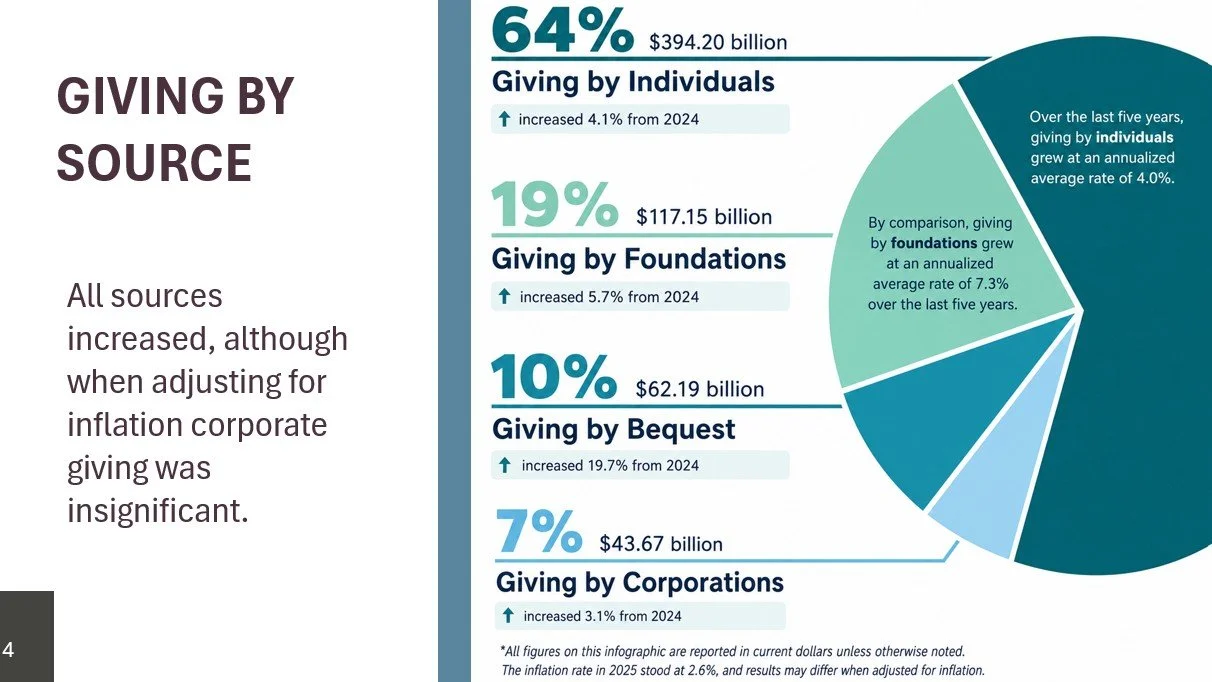
See more data visualizations in the Executive Summary Deck.
Bequests – 19.7% Growth (Current Dollars)
Many headlines identify bequests as a promising area of growth, having increased by about 20% or more in current dollars in three of the last four years.
Bequest giving fluctuates substantially from year to year, but it continues to follow an upward trend, similar to overall charitable giving.
However, over the past five years, bequest giving has outpaced overall giving growth. For this reason, experts are highlighting the exciting possibilities provided by bequests.
Foundations – 5.7% Growth (Current Dollars)
Foundations remain the second-largest source of giving after individuals, surpassing $100 billion for the third consecutive year.
However, after adjusting for inflation, the growth appears less significant, particularly when looking at the longer-term trend over the past decade.
Individuals – 4.1% Growth (Current Dollars)
Total individual giving continued to grow in current dollars, yet consumer sentiment remained low, which likely impacted charitable giving among some households.
As a percentage of disposable personal income, individual giving remained at a low of 1.7% over the past three years, the lowest it has been in the past decade.
Even more staggering, only about half of U.S. households are currently making charitable gifts, down from two-thirds in 2008.
In 2025, mega‑gifts totaled $19.22 billion, a significant increase from $11.72 billion in 2024 and making up about 4% of all individual gifts.
Additionally, a report by Blackbaud confirms the average gift size has nearly doubled in the last 10 years, from $727 in 2016 to $1,346 in 2025.
Corporate – 3.1% Growth (Current Dollars)
Corporate giving has grown, but not as quickly as corporate profits. This means companies are giving more money overall, yet philanthropy represents a smaller share of corporate earnings than it did in the 1980s and 1990s.
Over the past decade, corporate giving has doubled in dollars, but its share of profits has remained relatively unchanged.
Corporate vs. Individual
To better understand the propensity of generosity between sources, I compared corporate giving as a percentage of pre-tax profits with individual giving as a percentage of disposable income. It may be surprising, but individuals are almost twice as generous as corporations.
In 2025, individuals gave approximately 1.7% of disposable personal income, compared to corporations giving approximately 1% of pre-tax profits.
If corporations contributed the same percentage as individuals, giving would increase by $28 billion.
Recipient Sector
There were no major surprises in the recipient sector analysis, with giving to eight of the nine recipient subsectors increasing.
The exception was foundations, which decreased 16.2%, but still remained the fourth-largest recipient subsector, with a total of $79 billion. As demonstrated by the accompanying slides, giving to foundations has historically been volatile year to year.
Education, public-society benefit, and environment/animals all experienced more than 10% growth in current dollars and have seen some of the largest annualized growth rates over the past five years.
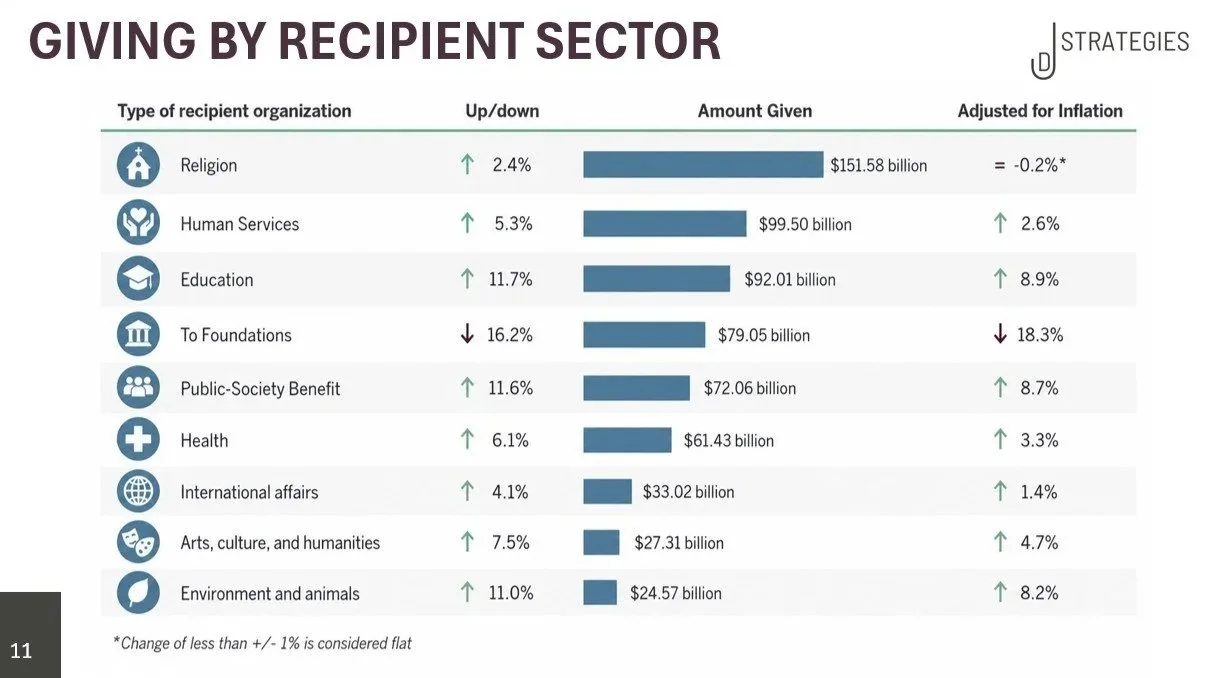
See more data visualizations in the Executive Summary Deck.
Activating the Insights
The question is not whether philanthropy is changing; it is whether organizations are adapting quickly enough.
Let’s explore what these trends mean in practice and how nonprofit leaders can turn these findings into actionable strategies to strengthen fundraising and position their organizations for long-term success.
Investing in Major Gift Relationships
The most impactful shift in the philanthropic landscape revolves around individuals. While individual giving remains the largest charitable source, fewer individuals are giving, and they are giving less of their disposable income. It is clear that the overall increase in giving by individuals is driven by a smaller base of committed major donors.
It may seem like bad news that the donor pool is shrinking, but the good news is those who remain are giving more to their carefully curated philanthropic portfolio. This is an opportunity. Major gifts have always been an incredible tool for transformation, and it’s even more important now to invest in these programs.
IMPORTANT TAKEAWAY: It used to be that 80% of funding comes from the top 20% of donors. Today, it increasingly feels closer to 10%.
To be clear, I’m not advising solely focusing on mega-giving, like the multi-million gifts doled out by billionaires either during their life or in their wills. While these are exciting opportunities for future growth, they are also unpredictable. Organizations cannot build a fundraising strategy hoping for these mega-gifts gifts to appear.
Organizations need to evaluate their major gift programs as a whole. What does this look like? Intentional investment in cultivation, stewardship, and long-term engagement. Deepening relationships with your donors. Ask yourself these questions:
How often you connect with your donors each year?
What is each donor’s mission is for giving?
Have you created an intentional donor journey for each major donor?
Even if your major donor is steadfast regardless of your engagement, do you go above and beyond to connect with them?
Is there a process to ensure you engage all donors, not just some ad-hoc?
Is stewardship an afterthought? Stewardship, the largest part of the equation, is often forgotten or overlooked. Now more than ever, stewardship like this is a financial necessity. Always remember, it costs way less to retain a donor than it does to acquire a new one.
After reviewing these questions, each organization needs to define their engagement goals and track them. All while showing up authentically to build real relationships.
This is not to denigrate annual gifts. Annual appeals will always remain an important part of fundraising, but they are increasingly unlikely to be sufficient on their own. Especially if they are untargeted and transactional. This perspective is not meant to ruffle feathers, but instead to encourage teams take an honest and intentional look inward and say, “is this about the donor or the dollars?” Are your donors mostly engaging in perks-focused donations, mass annual appeals with little segmentation, and annual events like galas?
This report is a wake-up call for all nonprofit and development leaders: do you truly know and steward your major donors?
The data makes it clear that sustainable fundraising requires an intentional investment in building authentic relationships that inspire long-term support. As organizations look to strengthen their major gift strategies, experienced fundraising leaders consistently point to the importance of balancing personal connection with disciplined stewardship.
Portia Fullard, Executive Director of the Leon H. Sullivan Charitable Trust, captures this balance well:
“I have always believed that people don’t simply invest in organizations—they invest in purpose, people, and possibility. Building and sustaining those relationships requires both heart and discipline. The heart lies in creating authentic connections rooted in trust and shared purpose. The discipline comes from building intentional systems and strategies that ensure every donor is known, valued, and meaningfully engaged. The most successful organizations understand that heart and strategy are not competing approaches—they are complementary strengths. The organizations that thrive will be those that master both.”
Investing in Generational Philanthropy
Let’s talk about the biggest headline: everyone is eagerly watching the increase in bequests, which rose roughly 20%, pushing total bequests beyond $62 billion. Experts are cautiously predicting that the long-awaited Great Wealth Transfer has arrived. While incredibly exciting, I want to caution against using this hope as a strategy. We have all heard stories about the unexpected million-dollar bequest from a small lifetime annual donor. I’m here to tell you that this is the exception, not the rule.
Planned giving is an incredible tool as a component of major gifts, but it requires foresight. Large bequests should not be surprises. What should you do to prepare your planned giving policy?
Formalize it: Every organization should have a basic planned giving policy, outlining exactly what gifts you accept, how you process and count them, and how legacy donors are recognized.
Become the expert (or partner with them): If you or your team have the capacity to dive deep, then learn all you can about planned giving opportunities because there are so many ways people can participate. If, like most organizations, you’re already at capacity, build relationships with trusted estate planning professionals who can advise your organization and interested donors.
Sell it: Brief your staff on the policy so they can discuss the opportunity with donors, as well as make sure legacy giving language is on the website and other materials. Sell the program!
This is another opportunity to engage your supporters, and they’ll appreciate that you’re creating more avenues for them to realize their ultimate philanthropic goals.
Planned giving is a long-term strategy, but how do you cultivate generational giving now?
Think beyond the individual and begin engaging families. It sounds simple, but it is incredibly common for organizations to steward donors as individuals. In many cases, gifts are processed under a single name, even when they come from a household or couple. Perhaps one spouse holds the longstanding connection to your organization, or one person manages the family's finances. Whatever the reason, many nonprofits recognize a family gift as belonging to just one individual, often defaulting to the husband as the primary donor when no other information is available.
This is a missed opportunity. Philanthropy rarely belongs to just one person. It is often a reflection of shared family values, priorities, and aspirations. And as wealth continues to transfer across generations, building relationships with individuals rather than families can become a significant risk as family dynamics evolve.
One powerful example of family philanthropy is the Rendell family. Honorable Marjorie Rendell, a Senior Judge on the U.S. Court of Appeals for the Third Circuit and former First Lady of Pennsylvania, has dedicated her career to public service and philanthropy. During her time as First Lady, she championed civic education for children. Later, she and former Governor Ed Rendell co-founded the Rendell Center for Civics and Civic Engagement, transforming a shared passion into a lasting family commitment. Their partnership demonstrates how families can come together around a shared mission and use their collective resources and influence to create enduring impact.
Even more heartening, that commitment has continued into the next generation. Their son, Jesse Rendell, serves as Executive Director of the Make the World Better Foundation, a Philadelphia nonprofit dedicated to transforming recreation centers and parks in underserved neighborhoods. Through partnerships with the City's Rebuild program, the foundation creates safe, high-quality spaces where children and families can thrive. Together, the Rendell’s demonstrate how philanthropy can become a multigenerational family legacy rather than the passion of a single individual.
When I spoke with Judge Rendell about her family's approach to philanthropy, she reflected:
“At some point in life, we realize that our impact day-to-day is marginal, but our impact on the future can be meaningful if we share what we have with organizations that can create a better life for others, now or in the future. It’s called philanthropy, but in some ways, we think it’s common sense. Our family has been blessed, and we derive pleasure from sharing that.”
The Rendell family reminds us that philanthropy is most powerful when it reflects shared values. By investing together, families build institutions and causes that endure well beyond any one generation.
The Smilow Foundation is an excellent example of how a family’s approach to philanthropy can endure across generations. CEO Bill Smilow describes the Foundation as grounded in his father Joel E. Smilow’s philosophy: “Do it now, leverage the gift, make a difference, and get accountability.”
While the Smilow Foundation remains true to his father’s philosophy, Bill understands that the landscape of giving is changing, and the Foundation must continue to consider how to make the biggest impact. In a recent conversation, he acknowledged that even after half a decade of building out the family foundation, he feels there is no blueprint for this work. Every family foundation approach giving differently, which means you’ll be charting your own course.
Bill recognizes that the structure and methodology of a foundation are just as crucial as the missions that drive them. Similarly, he understands that lasting impact is a large task that requires collaboration across funders, nonprofits, public investment, and other partners, with accountability built into the model. He demonstrates the intentionality funders bring to this work, always considering how they can make a difference and leverage their gifts to do more for the greater good.
When asked what he looks for in a grantee, Bill emphasized the importance of alignment with the Foundation’s mission and a desire to build collaborative relationships.
“For us, it starts with mission alignment. We want to attract organizations that are doing work where we believe we can make a difference and where our support can have a meaningful impact. From there, we want to build a deeper relationship to understand what the organization is trying to accomplish and figure out how we can best support them. That gives us the opportunity to leverage our investment and hopefully make a much bigger impact together.”
Thankfully, philanthropy is headed away from transactional grantmaking and toward more intentional, lasting partnerships. The strongest relationships between funders and nonprofits will ultimately be those where both sides see themselves as partners in creating greater impact.
So how can organizations prepare for changing family dynamics?
Look beyond the individual donor. Build relationships with spouses, children, and future decision-makers.
Deeply understand family philanthropy philosophy.
Invite families to site visits and volunteer opportunities.
Create meaningful engagement for younger generations through initiatives like young professionals advisory boards.
Even small changes, such as addressing communications to both spouses or recognizing family giving rather than individual giving, reinforce that your organization values the family as a whole.
When an entire family understands and embraces your mission, your organization becomes part of their philanthropic identity. As wealth transfers from one generation to the next, those relationships are far more likely to endure, grow, and inspire future giving.
What Next?
The Giving USA 2026 report provides a valuable snapshot of philanthropic trends, but the real opportunity comes from turning these insights into action.
Organizations best positioned for long-term success will be those that invest in their major gift programs, strengthen stewardship strategies, incorporate planned giving into their fundraising approach, and intentionally build relationships across generations.
At JD Strategies, I work alongside nonprofit organizations to translate trends like these into practical fundraising strategies that strengthen development programs and build sustainable revenue. Whether it’s designing a major gifts strategy, strengthening donor stewardship, developing grant funding opportunities, or helping organizations prepare for the future of philanthropy, my goal is to help nonprofits move from reacting to change to planning for it.
References & Resources
Fundraising USA Foundation. Giving USA 2026: The Annual Report on Philanthropy for the Year 2025. Indiana University Lilly Family School of Philanthropy; 2026. Available at: www.givingusa.org
Lilly Family School of Philanthropy. (2026). US charitable giving increases 5.7% to $617.20 billion in 2025 [Press release]. Indiana University. https://www.facebook.com/IULillyFamilySchoolofPhilanthropy/posts/just-released-giving-usa-2026-the-annual-report-on-philanthropy
Association of Fundraising Professionals. (2026, April 21). The Fundraising Effectiveness Project. https://afpglobal.org/FundraisingEffectivenessProject
Blackbaud Institute. (2026, March 18). 2025 Trends in Giving. https://institute.blackbaud.com/resources/2025-trends-in-giving
World Economic Forum. (2026, May 5). The Great Wealth Transfer won’t change finance on its own, but wealth owners can. https://www.weforum.org/stories/equity-diversity-and-inclusion/great-wealth-transfer-wont-change-finance-on-its-own/
